“Cadillac, the Standard of the World”
 Young people today probably have no idea of Cadillac’s former glory, or its place in automotive history. Unfortunately, the changing world has moved the brand to a place where it’s more famous for its SUVs than for its premium luxury cars. In fact, even those are more sport sedans. The world has changed and Cadillac has changed with it. But it’s been a long and storied ride.
Cadillac was founded on August 22, 1902 in Detroit by Henry Leland, a master machinist and engineer. The company was named after Antoine de la Mothe Cadillac, a French explorer who founded Detroit in 1701. By 1903 they were building cars. Their first was the Model A, a single-cylinder 10 hp rig with chain drive. But as primitive as it was, this wasn’t just any car. At the time, most carmakers were literally hand-building their cars. Every part was crafted to fit its application, often using blacksmithing techniques. A part made for one car only fit that car, and couldn’t be used on another
without some ‘fitting’. The Cadillac Model A was the first car ever to use
interchangeable parts. Every part worked on every car Cadillac built.
It was a revolutionary concept that was demonstrated to the world at the 1908 London Auto Show. Three Cadillacs were disassembled in front of the crowd, the parts mixed up, then all three cars went back together and started right up. The crowd was amazed. This had never been done before. This resulted in Cadillac receiving the coveted Dewar Trophy from the Royal Automobile Club in London for the precision manufacturing that would make Cadillac famous. It was a milestone in automotive history, and it earned Cadillac the nickname “The Standard of the World”.
One year later, William C Durant, founder and president of General Motors, bought Cadillac for $4.5 million and turned it into GM’s luxury division. With GM’s already formidable resources backing them Cadillac continued their tradition of innovation. In 1912 Cadillac introduced the world to the first electric starter. Charles Kettering invented it while at Cadillac and it revolutionized the automobile. Until then, you had to crank the motor by hand to start it. This was beyond most women and some men. It was also dangerous. If the engine kicked back, the crank could swing back violently.
In fact, as the story goes, a personal friend of Kettering’s died when the crank kicked back and broke his jaw. He died from the complications and Kettering swore to find a solution so that this wouldn’t happen to anyone else. So, every time you start your car without thought, thank Cadillac.
Throughout the 1920s, the ‘Roaring Twenties’, they continued to lead the industry while establishing themselves as the premium luxury brand. They introduced closed bodies, V8 engines and other advanced features. In 1930, in the height of the Great Depression, they introduced their 452 ci (cubic inches) V16, the first production car to have a V16. They also had a V12. The V16 was a 7.4-liter OHV (Overhead Valve) beast that breathed through two tiny Stromberg updraft carburetors making 165 hp. The V12 had 368 ci, was also an OHV design and made 135 hp. Cadillac introduced its new Series 60 Special in 1938, considered a landmark luxury sedan and a nameplate that
would endure for decades.
Of course World War II intervened and from early 1942 through 1945, all civilian car production was halted while all the factories made war materials. Cadillac famously produced tanks, airplane engines and other things. Civilian production resumed with the 1946 model year, but due to the full concentration on the war effort over the past four years, there were no new designs in the works. But when Pearl Harbor hit on December 6, 1941, GM had already been producing 1942 model year cars for five months. All the tooling was done, everything was there. And after four years of war
America was ready to buy some cars. So Cadillac did what they all did, they fired up the production line, tarted up the 1942 models with some new trim, then called them 1946s. America was so hungry for cars that they were buying anything with wheels on it. But as production ramped up, the market calmed down a bit, although growing strongly every year.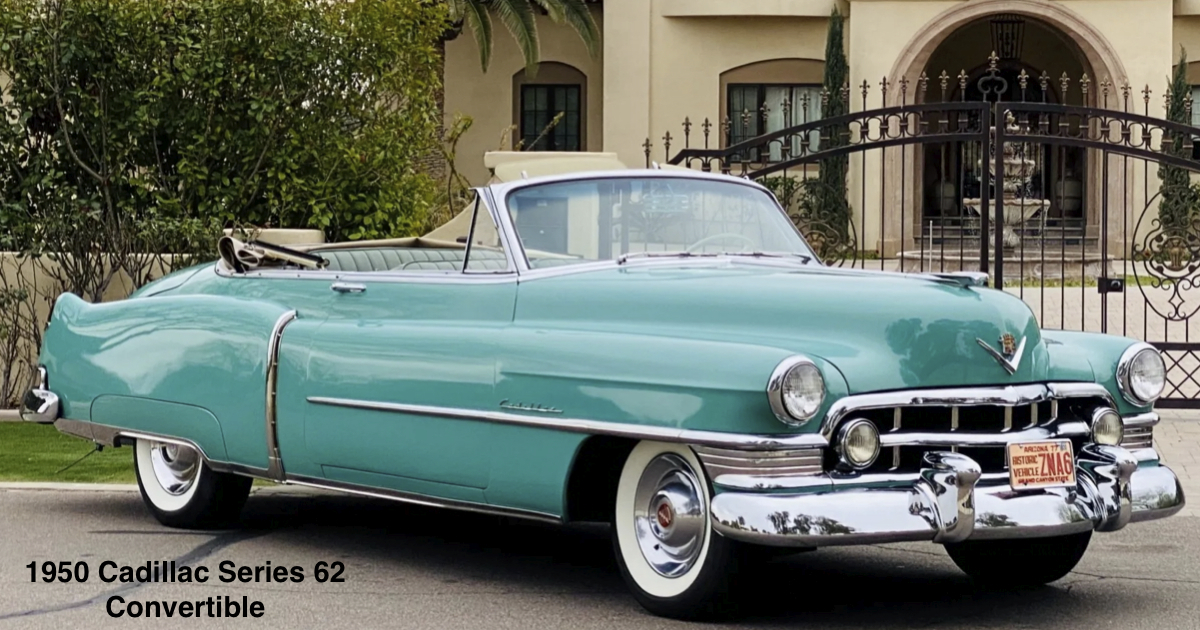
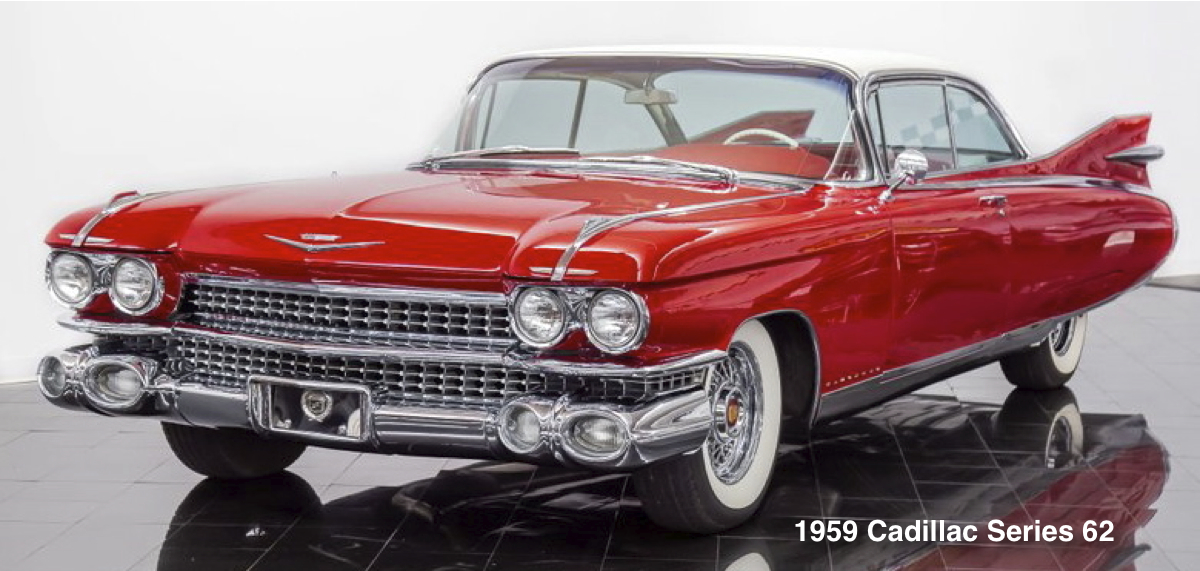
Cadillac can literally take credit for, or be blamed for, the tail fin craze. Their 1948 models were the first to show any vestige of a tail fin. Conceived by GM’s legendary Design Chief Harley Earl, they were inspired by the twin tail booms on the P38 Lightning fighter plane of World War II. Every 1948 Caddie got them, and each year they grew. Cadillac’s tail fins were not only first, they were also the biggest. By 1959 Cadillac’s tail fins were huge and garishly trimmed in way too much chrome. The long chrome spears running down the sides of the car were attached with fasteners that popped through holes in the body, and since the trim slowly narrowed toward the back, each fastener was unique. And there were hundreds of them in all. This is the way Cadillacs were put together in those days, and one reason why they suffered from corrosion later in life. The 1959s were bold, gaudy, huge, and in-your-face. Thank goodness 1959 was the peak of the tail fin era. The 1960 models had toned-down fins and they continued to tone down, getting smaller and more subtle each year until they were mostly gone by 1965 or so. However, a vestige of the tail fin has always remained
in Cadillac styling, all the way up to modern times. You can see it in the vertical tail lights on a new Caddie.
It takes about 3 to 5 years to take a new car from concept to production. Postwar civilian production resumed in 1946 and it took until model year 1949 for the genuinely new models to come out. Compared to the old ones, designed before the War, these new cars were sleek, modern, lower, wider and just…better. By this time Cadillac was truly America’s luxury brand and they were proving it with cars like the 1953 Eldorado convertible, the Series 62, and at the top of the heap, the 1957-58 Eldorado Barritz (officially called Brougham). Only 904 of these ultra-luxury flagships were built making
them worth as much as $300,000 today in collector car auctions. But they were expensive back then as well. The MSRP of a 1957 Eldo Barritz was $13,074, more than a Rolls Royce at the time. A 1957 Corvette went for $3,176.
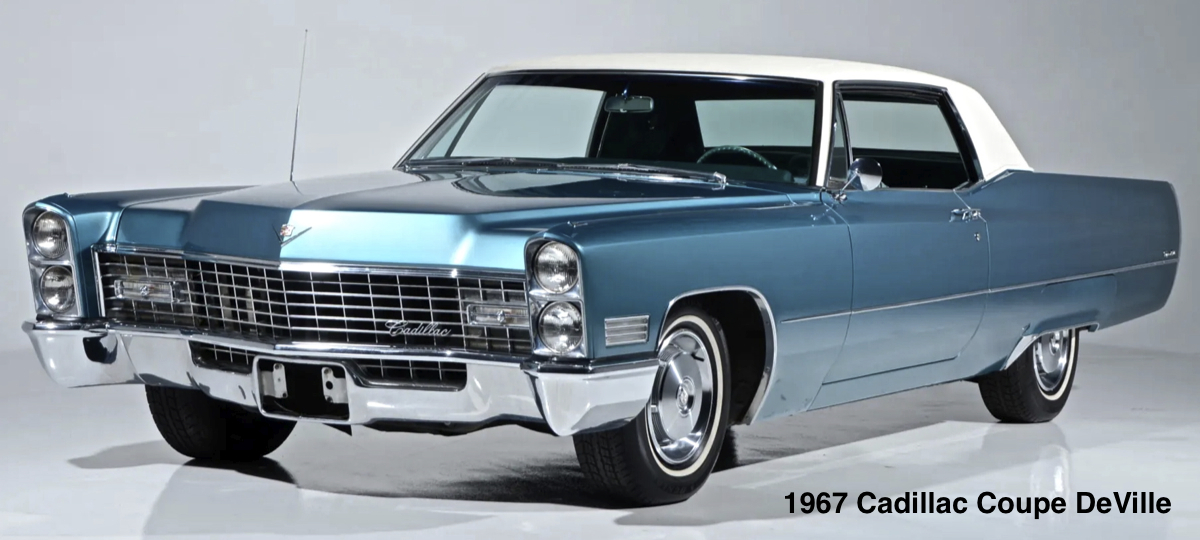 The 1960s were good to Cadillac. They entered the decade making around 148,000 cars per year, and by 1970 that number had grown to 210,000 cars. It had been a steady growth, free of spurts and fits. And the sales numbers just kept growing right up into the 1980s. In 1980 Cadillac produced 310,000 cars. The 60s also had some great Cadillacs. Sedan Devilles, Coupe Devilles, Fleetwood, and Eldorado. The Eldo changed significantly in 1967. Until then, it had been a fancier version of Deville convertible, but in 1967 it went front-wheel drive. Oldsmobile had just come out with its radical front-drive 1966 Toronado and GM wanted to amortize out the tremendous cost of that development program with a Cadillac version. While both cars were built
on GM’s new E-platform, its first-ever with front-wheel drive, there were differences besides the looks. Of course they had different engines, the Caddie with its 429 V8 making 340 hp and Olds with their 425 ci Rocket V8 with 385 hp, and there were subtle tuning, trim and feature differences between the two. Generally, the Toronado was sportier and aimed at a younger buyer.
The 1970s saw much turmoil in the market as the Malaise set in. Tough government regulations addressing smog, fuel economy and safety, along with lead being removed from the gas and soaring insurance rates was killing the high-performance car market. And all during the 1960s it seemed every brand had been cashing in on the muscle car craze. But, Cadillac was never any part of that, so when it ended, it had little effect on
them. Cadillac’s sales continued on as always, steadily growing right through the 1970s.
In 1975 Cadillac released a radical new car for them, a smaller, more economical luxury sedan, the Seville as a 1976 model. It was an instant hit and sold 43,466 cars its first year. Despite being their smallest model, the Seville was the most expensive model Cadillac was selling. Built on the K-body platform, shared with the rear-wheel drive Olds Cutlass and Pontiac Grand Prix among others, Cadillac engineers managed to build a feeling of quality and luxury into it despite its humble roots. The smaller, lighter car didn’t need a 500 ci Cadillac V8, a smaller engine was needed and Caddie didn’t make one. So they used the L26 Oldsmobile 350 making 180 hp. It came with a Bendix EFI (Electric Fuel Injection) system, GM’s first on a V8.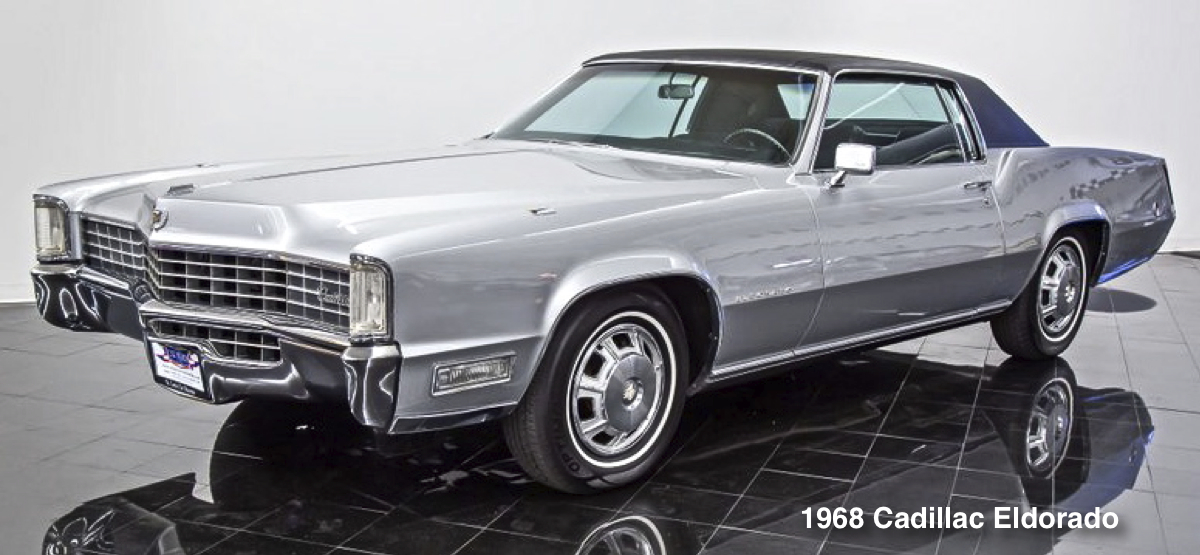 The Seville was meant to go toe-to-toe against Mercedes and BMW. That didn’t go too well. Despite their move into a younger buyer strata, they still weren’t the same ones buying European. Those people didn’t take the little Cadillac, any Cadillac seriously and that was beginning to be a problem, a very big problem. Demographics move as generations grow old, markets change, economics rise and fall and through it all Cadillac was losing its core market. They used to be regarded as the world’s premium luxury car, rivaling anything from anywhere, the car you wanted to drive once you’d ‘made it’. Driving a Cadillac used to signify your success, your status. But that was all changing. That brand snobbery had left our shores and landed in Germany. Starting in the early 1980s, owning a Mercedes or BMW was a sign of prosperity and intelligence. Cadillacs were increasingly being thought of as “a relic of the past”, or “my father’s car”, or worse “my grandfather’s car”.
In 1982 Cadillac decided it needed to move down market to capture more younger buyers, so they launched one of their most problematic and controversial cars of all time, the Cimarron. Being built on the J-body front-drive platform meant it shared its bones with the humble Chevrolet Cavalier, Pontiac J2000, Olds Firenze and Buick Skyhawk. It launched with a rumbly 1.8-liter 4-cylinder making 88 hp, which was later upgraded to a 2.0 with 110 hp, or an optional V6 with 135 hp. They didn’t even bother to reskin the Cavalier, it was essentially a facelift, where just the front and rear facias
were changed along with some trim and a new leather-swathed interior. With a big Cadillac grille on the front of it with a hood ornament. It wasn’t nearly enough and the public figured it out rather quickly. It turns out they didn’t like paying Cadillac prices for a Chevy. The car bombed and with it some of Cadillac’s hard won reputation.
Perhaps in an effort to win some of it back, Cadillac unveiled its first truly new engine in decades, the DOHC 32-valve Northstar V8 in 1993. It was a gorgeous all-aluminum feat of engineering but unfortunately early engines suffered head gasket failures and head bolt threads pulling out and it ruined the reputation of this fine engine. Built in 3 generations, produced through 2009 during which time it made from 275 to 315 hp in naturally-aspirated form and 439 hp in the supercharged LC3. It was dropped in favor of the much cheaper and more reliable LS family of Chevy engines from the Corvette.
Cadillac discovered a whole new world when it introduced the Escalade full-sized SUV in 1999. It turned out to be a monster hit with rappers and movie stars and by 2003 it has become Cadillac’s biggest seller. In 2000 Cadillac abandoned all the names of its cars in favor of ‘letter names’ like CTS
(formerly Catera), DTS (formerly DeVille) and later the XLR and SRX. It probably confused the market but it seemed to help sales slightly. Perhaps Cadillac was trying to cut the ties from its past. A shame really, when one considers how proud they used to be of their heritage.
The 2004-2009 Cadillac XLR was a reimagined Corvette built on the C6’s chassis butwith 4.6-liter Northstar power (320 hp). The 2006-2009 XLR-V used a 4.4-liter supercharged Northstar good for 469 hp. All had either 5- or 6-speed automatics. All had power-retractable convertible hardtops. Prices were sky-high at the time, $75-85K, $100K+ for the XLR-V and total sales for all 6 model years totaled around 16,000 units. But it was a halo car for the brand and that’s a good thing.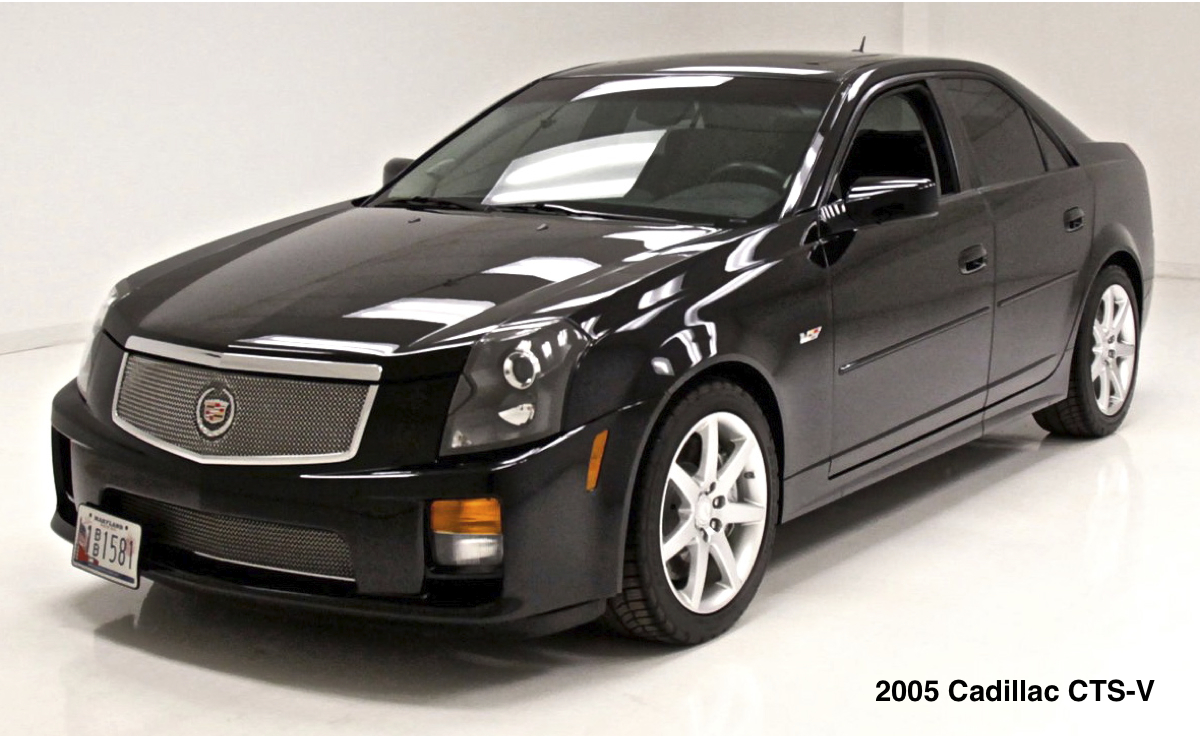 Starting in 2003 with the CTS, Cadillacs took on a sharply-angled, slab-sided, stealth fighter-look that was a little alarming at first. Then, that look began to spread across Cadillac’s entire lineup. It became the brand’s signature look. And it was sort of a love-it-or-hate-it affair. Traditional Cadillac fans hated it, but someone must have liked it because CTS sales climbed from 35,000 in 2003 to 70,000 in 2007. In fact, overall sales of the Cadillac brand also improved during the adoption of the “Art & Science”
look, as Cadillac named it. 145,000 sales in 2003 and 232,500 in 2007. Then the housing crisis hit and sales fell and continued to fall. They hit a low of 120,000 cars in 2011 but have recovered, slowly and steadily. They sold 350,000 cars in 2025, their best year ever.
In the 2026 model year the Cadillac lineup consists of two sedans, the CT4 ($36K) and CT5 ($40K), both with 4-cylinder turbo power; two crossovers, the XT4 ($37K) and the XT5 ($44K) also both with turbo 4’s; two SUVs, the XT6 ($50K) with 4-cylinder turbo, and the full-size Escalade ($82-100K+) with 6.2-liter 420hp V8 or supercharged with 682 hp in the Escalade-V.
Then, we get into the electrics. GM spent a literal fortune converting over to EV production because of the Biden mandates and it took much-needed money away from developing the vehicles that people actually want to buy. Lyriq is Caddie’s best selling EV with 40,000 sales in 2025. The new Optic launched in late 2025 and sold roughly 3,000 units. Same with the Vistiq with around 2,000 sales in 2025. The Escalade IQ is a fully electric SUV that seems to be struggling at 10,000 sales for 2025. Obviously Cadillac is betting heavily on an all-electric future. But at what cost? If all their gas-powered cars are 4-cylinders they’re no fun anyway. It’s hard to imagine 4- cylinder Cadillacs.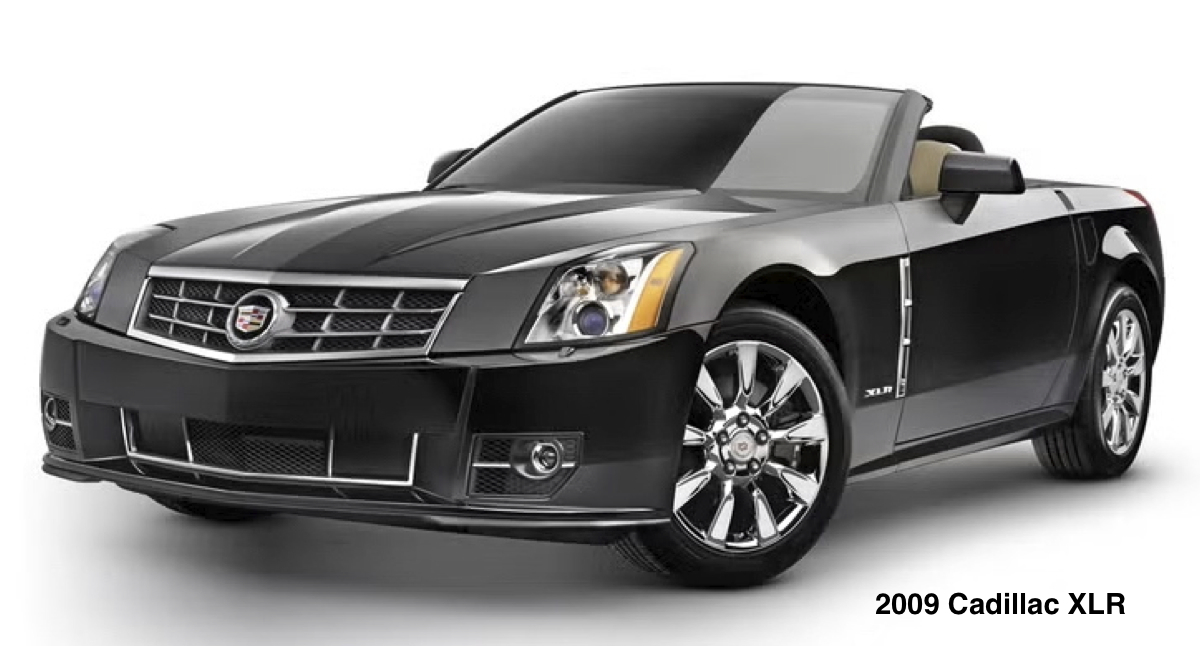
Today, more than a purveyor of luxo-barges like before, Cadillac wants to become known, and has become known as a maker of fine high-performance luxury sports sedans, crossovers and one big-ass SUV. At one time they leaned on Corvette power but now it’s all turbo 4s. The only V8 left is in the Escalade, a vehicle that the classic Cadillac of old would never have considered building. Lately, there have been reliability and quality issues that have further harmed the brand’s image. There have been
technical problems, and as cars get more and more tech-laden these problems will likely persist. Then of course inflation and bad corporate management have driven the cost of new cars out of reach for most buyers today. All of these things should conspire to hurt Caddie’s sales yet they’ve just had their best year eve. The biggest issue, and their biggest loss is one of reputation and public image. And you can’t just buy that back or win it back with racing victories or fancy new models. It took decades to build and decades to lose. Will they ever win it back? Only time will tell.